
F-Gas stands for fluorinated greenhouse gas. These gases are used in some air conditioning systems as refrigerants, which absorb heat from a room and release it outside. Some refrigerants have a much stronger warming effect than carbon dioxide, so leaks can contribute to climate change. UK regulations control how these gases are handled, recovered and released into the atmosphere.
If you own an air conditioning system, you should understand which refrigerant it uses, why leaks matter and why certain installation and repair work must be carried out by qualified professionals.
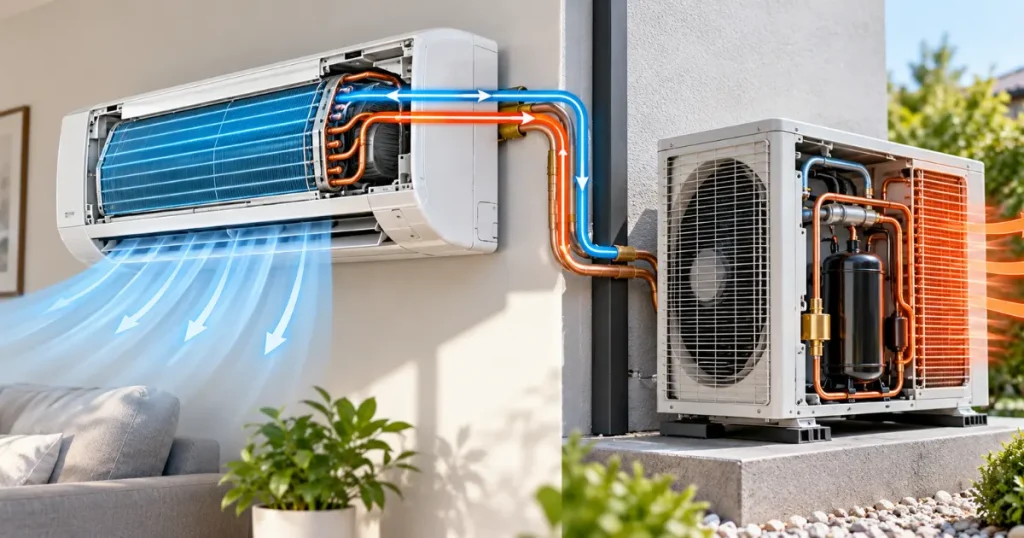
How Does F-Gas Work in an Air Conditioner?
An air conditioner uses refrigerant to transfer heat between the indoor and outdoor units. The refrigerant circulates through a sealed circuit, changing pressure and state as it absorbs heat indoors and releases it outdoors.
During cooling, the refrigerant absorbs heat from the room and carries it outside. Reversible systems can also work in the opposite direction to provide heating.
F-Gases include hydrofluorocarbons (HFCs), some of which have been widely used in air conditioning systems. However, not every refrigerant is an F-Gas. For example, R32 is an F-Gas, while R290, also known as propane, is not a fluorinated gas.
HVAC F-Gas: Why Does It Matter?
1. F-Gas Can Contribute to Global Warming
Some F-Gases trap far more heat in the atmosphere than the same amount of carbon dioxide. Their environmental impact depends on the type of refrigerant and how much escapes.
Preventing leaks helps reduce these emissions. This is one reason manufacturers and regulators are moving towards refrigerants with lower global warming potential (GWP).
2. Refrigerant Leaks Can Affect System Performance
An air conditioner needs the correct refrigerant charge to work as designed. If refrigerant escapes through a leak, the system may struggle to cool or heat the room properly.
Possible warning signs include reduced performance, longer running times and unusual changes in operation. These symptoms can have other causes too, so a qualified technician should inspect the system rather than assuming it needs more refrigerant.
Important: Refrigerant does not normally need topping up as part of routine maintenance in a correctly sealed system. If the level is low, the technician should investigate the cause and repair any leak where necessary.
3. F-Gas Work Is Regulated
In the UK, specific qualifications and company certification requirements apply to relevant work on air conditioning systems containing F-Gases. This includes activities such as installation, maintenance, refrigerant recovery and leak checking, depending on the work involved.
Businesses carrying out regulated work on stationary air conditioning systems for other customers must have the appropriate company certification, and technicians handling refrigerants must hold the relevant qualifications.
What Are the Common Refrigerants Used in Air Conditioning?
Different air conditioning models use different refrigerants. The type matters because refrigerants have different environmental impacts, operating characteristics and safety requirements.
| Refrigerant | Key information |
| R32 | An F-Gas used in many modern air conditioning systems. It has a lower global warming potential than R410A but is mildly flammable, so equipment must be installed and serviced correctly. |
| R410A | An older, widely used HFC refrigerant with a higher global warming potential than R32. Its use in new equipment is subject to restrictions. |
| R290 | Propane, a non-fluorinated refrigerant with a very low global warming potential. It is flammable and requires equipment designed for its safe use. |
The refrigerant used by your system should be shown on its label or in its technical documentation. Do not choose or substitute a refrigerant yourself. The equipment must be designed for the specific refrigerant it uses.
UK rules also restrict certain high-GWP refrigerants in new equipment. For example, restrictions introduced from 2025 apply to specified single-split air conditioning systems containing less than 3 kg of refrigerant when the refrigerant has a GWP of 750 or more, subject to the applicable exceptions.
Does Your Air Conditioner Need an F-Gas Leak Check?
Not every domestic air conditioner automatically requires a statutory F-Gas leak check at fixed intervals. The legal requirement depends on factors including the refrigerant, the quantity in the system and its carbon dioxide equivalent.
Certain stationary air conditioning systems must undergo scheduled leak checks. Where a leak is found, it must be repaired as soon as possible, and the repair must be checked to confirm that it has worked.
Even where a statutory leak check is not required, you should arrange an inspection if your system loses cooling performance, shows signs of damage or appears to have a refrigerant leak.
Do not attempt to open the refrigerant circuit or release gas yourself. Contact a qualified air conditioning technician.
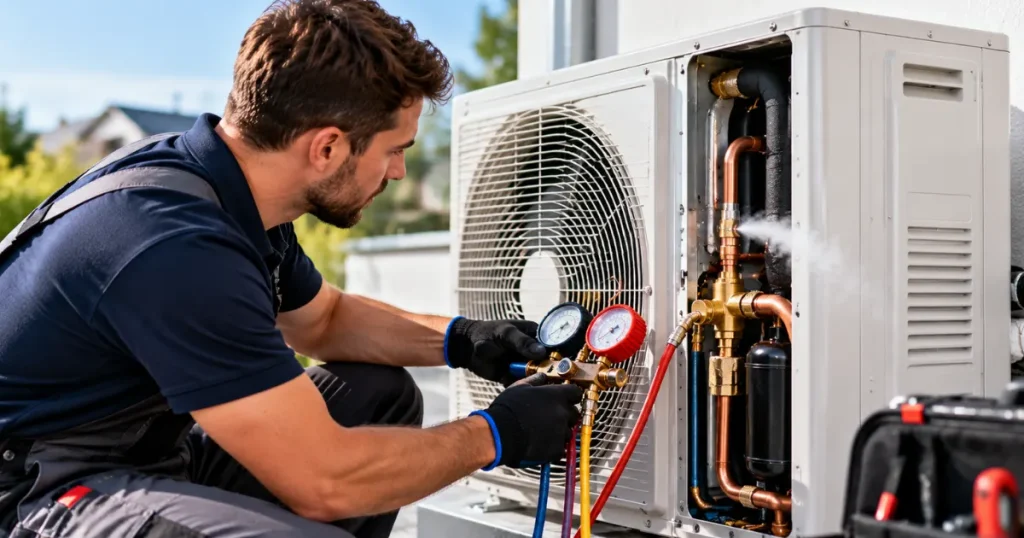
What Should You Do If Your Air Conditioner Has a Refrigerant Leak?
If you suspect a refrigerant leak, take these steps:
- Stop using the system if it appears damaged or unsafe. Follow the manufacturer’s instructions and seek professional advice.
- Arrange a qualified inspection. A technician can check the system and identify whether refrigerant has escaped.
- Repair the source of the leak. Simply adding refrigerant without addressing an existing leak is not a proper long-term solution.
- Have the system tested after repair. The technician should confirm that the repair has worked and recharge the system correctly where necessary.
- Keep service records. Records can help track repairs and refrigerant work, and certain equipment is subject to legal record-keeping requirements.
How Can You Reduce F-Gas Problems?
You can reduce the risk of refrigerant loss and unnecessary emissions by arranging suitable maintenance, keeping the outdoor unit clear of obstructions and dealing with performance problems promptly.
Do not ignore repeated cooling problems or assume that every fault requires a refrigerant refill. Dirty filters, airflow restrictions, electrical faults and drainage problems can also affect an air conditioner’s performance.
When installing a new system, ask which refrigerant it uses and consider its energy efficiency, operating requirements and environmental impact alongside the purchase price.